
Who Reported Me in Dota 2? How to Actually Find Out
Short version: inside the Dota 2 client you can't. Reports are anonymous by design. But the match replay quietly records who pressed the Report button and at what minute, so there's a real answer hiding in a file you already have access to. Here's what's true, what's myth, and why those paid "we deanonymize Valve reports" services are just a scam wearing a Dota skin.
What Valve actually hides
The report system is anonymous on purpose. You never get a "player X reported you" popup, and there's no list of names anywhere in the client. Valve built it that way so nobody hunts a teammate down for one click. So let's kill the first myth right now: there is no in-game way to "see who reported you." If someone swears they can pull it "straight from Valve's database," they're lying to you. That data never leaves Valve's servers.
What Steam itself shows you
A bit of official ground truth to close the loop. Valve has a Personal Game Data page (GCPD), and reports really do live there, with one important asymmetry. Your outgoing reports (who you pressed Report on, in which matches and for what) are shown by name. But incoming ones (who reported you) come back anonymized: counts and categories only, not a single username. So even Valve's own tool, by design, shows who you reported and hides who reported you.
Open your outgoing reports in Steam → you'll need to be signed in to Steam in your browser
Which is why that anonymized page isn't enough to learn who pressed Report on you. One working path remains: parsing the public replay minute by minute, which is what the section below is about.
What you can see, and where it comes from
Every game gets written to a public replay. That replay stores in-game events, and Report button presses are one of those events. We grab the public replay and parse it. What comes out:
- which of the ten players pressed Report, and on whom;
- the exact minute it happened;
- what was going on around it: chat flame, a ping war, a death on the lane, a fight you threw.
This is not deanonymizing anything and not touching Valve's servers. It's reading what already sits in the open replay, the same file anyone can download. Full walkthrough is in our Dota 2 report tracker guide.
Check your match by Match ID →
Red flags: how to spot the scam
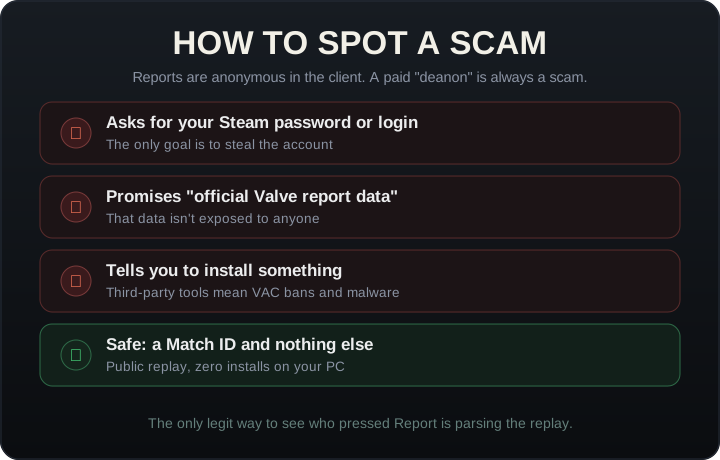
The deanon "services" all leak the same tells. Any one of these and you close the tab:
- They ask for your Steam password or login. Never needed. A Match ID is enough to parse a game. The only reason to ask for your password is to steal the account.
- They promise "official Valve report data." That data isn't exposed to anyone. Hearing it pitched is the scam marker by itself.
- They tell you to install something. The replay is a public file. No injection, no client mod, nothing on your machine. Third-party tools mean VAC risk and malware, full stop.
A safe lookup runs the exact opposite way: Match ID only, public replay only, nothing installed on your PC.
Why even bother knowing?
Mostly to figure out why your behavior score keeps sliding and quit guessing. Sometimes it's a teammate who said nothing all game, then tapped Report at the GG screen out of pure spite. Sometimes it's an enemy who tilted after you stomped his lane and wanted the last word. Seeing the actual cause lets you shrug off what was never on you and fix the parts that were. More on the score itself in why your behavior score drops.
FAQ
Is this against Dota 2's rules? No. Parsing a public replay breaks nothing and never touches another account. You're reading an open file, that's it.
Can I check an old match? If Valve still has the replay, yes. They keep them about two weeks after the game, then it's gone from their servers. Pull the Match ID before it expires.
How many reports actually hurt me? Not all of them count. The weighting is broken down in how you end up in low priority.